GERSTMANNITE
MnMgZn(SiO4)(OH)2,
manganese magnesium zinc silicate hydroxide
Gerstmannite was found in the Sterling mine in the early 1970s, in 1120 stope above 1100 level, along the west limb of ore, as pale pink (nearly white), bladed crystals arranged in fan-shaped groups in a vein cutting granular willemite-franklinite-calcite ore (GST1). In the picture at right, Ewald Gerstmann is inspecting specimen GST1 under a binocular microscope. Initially it was regarded as nonfluorescent radiating willemite; other guesses included a zeolite and nonfluorescent calcite. The mineral was sufficiently strange, however, that several attempts were soon made to identify it. 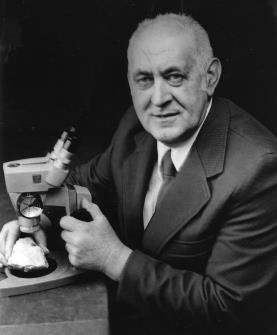 Dr. Warren Miller, a professional chemist and collector of the local minerals, set out to determine its composition. Jack Baum, retired Franklin mine geologist and curator of the Franklin Mineral Museum, submitted fragments both to Harvard University and the New Jersey Zinc Company laboratories in Palmerton, Penn. It soon became clear that the unknown was a mineral new to science. In 1975, by fortuitous circumstance, a visiting professor, Dr. Paul Moore from the University of Chicago, noticed a specimen of the “nonfluorescent radiating willemite” on display in Ewald Gerstmann’s private mineral museum in Franklin and asked if he might study the mineral. Dr. Moore soon got to work. In 1976 the new mineral was approved by the International Mineralogical Association, and in 1977, upon publication of the formal description of the species (Moore and Araki, 1977), gerstmannite joined the long list of minerals first discovered in the Franklin-Sterling Hill area. Gerstmannite remains a single-locality mineral and is known only from the Sterling mine; it has not been found at Franklin.
It should be mentioned that the early history of gerstmannite is one of the more fascinating tales of local mineral lore, involving competition for specimens, bruised feelings, misunderstandings, accusations of betrayal, and more. Parts of it, the parts suitable for print, have been nicely summarized by Sanford (2019) and Lowell (2019). Competition for specimens remains fierce (and not always honorable), in part because so few specimens are known. Moore and Araki (1977) accounted for nine of them, and it is probable that fewer than 20 were initially recovered. Some may since have been subdivided.
The original gerstmannite is part of a layered vein assemblage consisting primarily of pale green willemite, dark brown sphalerite (fluorescent orange LW), and white calcite (GST1, GST3). Gerstmannite is the last of these minerals to form in the vein. Gerstmannite was regarded as a nonfluorescent species until 2014, when it was observed to fluoresce dull olive-green under the blue light from a powerful dive light used in marine biology (Mazel and Verbeek, 2014; Bostwick, 2016). A dim gray fluorescence was also observed under conventional longwave UV lights.
Gerstmannite from a wholly different find until recently was represented by a single specimen in the collection of Steven Kuitems, DMD, a vigilant collector of Franklin-Sterling Hill minerals. This specimen, formerly in the collection of Richard A. Kosnar (Mineral Classics, Colorado), was sold as zincite but also contains translucent, orange-tan crystals of gerstmannite up to 8 mm long in a vein cutting coarse-grained calcite marble (GST2). The gerstmannite was confirmed as such via Raman spectroscopy by Dr. Hexiong Wang of the University of Arizona. A second specimen from this same assemblage has since emerged.
References
Bostwick, R.C. (2016), Fluorescent Minerals of Franklin and Sterling Hill, N.J., Part 1. The Picking Table, vol. 57, no. 2, p. 10-22. [Describes fluorescence of gerstmannite on p. 18]
Dunn, P.J. (1995), Franklin and Sterling Hill, New Jersey: The world’s most magnificent mineral deposits. Privately published, 755 pp. [Describes gerstmannite on p. 369; chemical analyses of three specimens, showing near-constancy in composition, in Table 3 on p. 365]
Edwards, F.Z. (1976), New minerals: gerstmannite. The Picking Table, vol. 17, no. 1, p. 7. [Announces approval by the International Mineralogical Association of gerstmannite as a new mineral species]
Edwards, F.Z. (1977), New Minerals: gerstmannite. The Picking Table, vol. 18, no. 2, p. 4-5. [Provides excerpts from the 1977 Moore and Araki paper]
King, V.T., King, N.E., Betancourt, P.P., Bostwick, R.C., Chin, Peter, Hecht, T.J., Kuitems, S.M., Moritz, Harold, Nemetz, J.D., Nikischer, A.J., Sanford, Stephen, Van Fleet, J.A., and Verbeek, E.R. (2022), The Mineralogy of Franklin and Ogdensburg, New Jersey—A Photographic Celebration. Privately published, 1400 pp. [Photos of gerstmannite shown on p. 116, 436, and 901]
Lowell, L.A. (2019), An historical perspective of two colorful individuals and a unique mineral. The Picking Table, vol. 60, no. 1, p. 22-23. [Entertaining account of Ewald Gerstmann, Judge Ervan Kushner, and their role in the recognition of the new mineral gerstmannite]
Mazel, Charles, and Verbeek, E.R. (2014), Fluorescence of minerals under blue light: The Picking Table, vol. 55, no. 2, p. 13-25. [First mention of fluorescence in gerstmannite]
Moore, P.B. (1996), Closest-packed mineral structures of Franklin-Ogdensburg: Kepler's gift of the snowflake (Part two of two parts): The Picking Table, vol. 37, no. 1, p. 17-32. [Interprets gerstmannite as a cubic closest-packed crystal structure and discusses its relation to clinohedrite]
Moore, P.B. and Araki, Takaharu (1977), Gerstmannite, a new zinc silicate mineral and a novel cubic close-packed oxide structure. The American Mineralogist, vol. 62, no. 1, p. 51-59. [Formal description of the species as a mineral new to science]
Sanford, Stephen (2019), How gerstmannite came to be. The Picking Table, vol. 60, no. 1, p. 21. [Good account of how specimens of a pink “nonfluorescent radiating willemite” ultimately were identified as the new species gerstmannite]
Simonov, M.A., Egorov-Tismenko, Yu.K., and Belov, N.V. (1978), The crystal structures of clinohedrite, Ca[ZnSiO4].H2O and gerstmannite (Mn,Mg)Mg(OH)2[ZnSiO4]. Doklady Academia Nauk SSSR, vol. 238, p. 1348-1350. Soviet Physics - Doklady, 23, 113-114. [Describes crystal-structural relationships between gerstmannite and clinohedrite]
Images
